
Diamond Authenticity Assessment
Diamond Authenticity Assessment
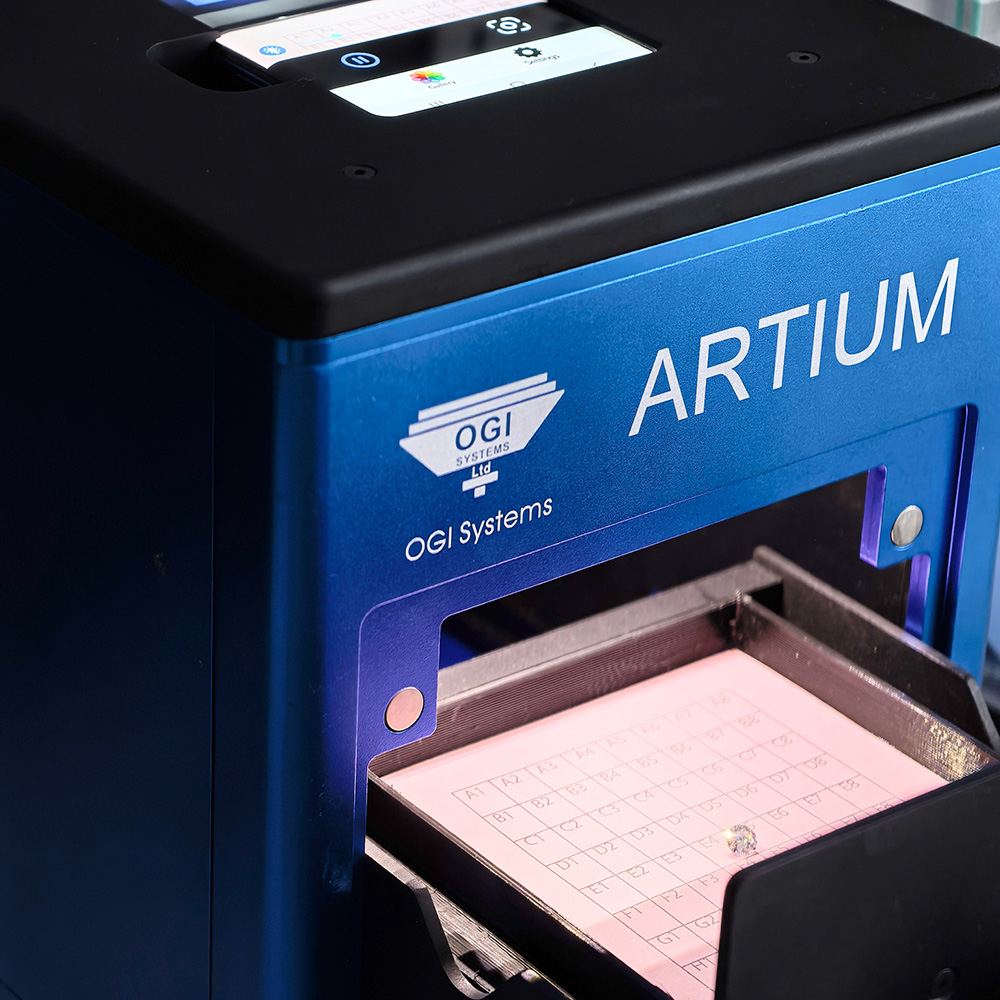
We invite you to our gemmological laboratory, where you can verify the authenticity of diamonds using the professional OGI DiaTrue Artium tester.
The tester allows identification of:
- jewelry with set stones (including rings, earrings, pendants, bracelets)
- loose stones (both single pieces and larger parcels)
The examination is non-destructive, takes only a few seconds, and is performed on-site, in your presence.
OGI DiaTrue Artium – a new standard in diamond identification
OGI DiaTrue Artium is a diamond tester that combines speed with precise screening of stones found on today’s market. It efficiently detects laboratory-grown diamonds (HPHT/CVD) as well as the most common imitations—even when set in jewelry—allowing you to base buying and selling decisions on facts rather than assumptions.

Wide detection range
Detects HPHT and CVD laboratory-grown diamonds, as well as moissanite, cubic zirconia (CZ), and synthetic diamond coatings on moissanite or cubic zirconia.

For jewelry and loose stones
Identifies cut stones set in jewelry (rings, bracelets, watches, delicate jewelry) as well as loose stones and melee, starting from 0.02 ct, in the D–K color range.

Express scan and 360° view
Very fast operation (scan time approx. 3 seconds) and real-time 360° preview, making it easy to inspect rings and bracelets from every angle.

Repeatable results
OGI DiaTrue Artium operates according to a standardized procedure, ensuring consistent and easily comparable test results.
Why is it worth it?
It is worth checking a diamond’s authenticity because natural diamonds can easily be confused with laboratory-grown diamonds or imitations—and these differences may mean an entirely different value.

There are many imitations and “diamond-like” stones on the market today, as well as laboratory-grown diamonds (HPHT/CVD) circulating and sometimes sold as natural.
In multi-stone jewelry, stones of different origin or quality are often found—sellers rely on supplier declarations and may not be fully certain what they are actually offering.
When is it worth checking?
Natural and laboratory-grown diamonds are not the same from a market perspective. If you plan to sell, buy, or appraise a stone, it’s important to know exactly what type of stone you are dealing with.
You are planning to purchase jewelry or a stone, especially from an uncertain source or secondhand.
You own a stone (loose or set in jewelry) but are not sure whether it is a diamond.
Furthermore, you suspect a stone replacement.
You want to quickly verify a larger number of items (e.g. commission shop, pawnshop).
The most common diamond imitations
Many stones look spectacular in jewelry and can closely resemble a diamond. Don’t be fooled by their brilliance. The market offers many imitations and widespread laboratory-grown diamonds whose market value differs significantly from that of naturally mined diamonds. Below are the most commonly encountered stones that resemble natural diamonds in appearance.
Laboratory-grown diamond
Moissanite
Cubic zirconia
YAG
Glass
What does the identification process look like?
Some imitations can look excellent in jewelry—especially under showroom lighting. That’s why a visual assessment alone can be unreliable. This is precisely why professional on-site verification exists: to separate visual impression from facts.
Visit to the laboratory
You bring your jewelry or loose stones.
Stone testing
We perform the test using OGI DiaTrue Artium – in your presence.
Result interpretation
Within just a few dozen seconds, you receive information on whether the diamond is natural.
Documentation
If needed, we prepare a written expert report.*
* If the result requires extended analysis, you will be informed accordingly.
FAQ
Can I check a diamond in a ring/earrings (set in jewelry)?
Yes. We test both stones set in jewelry and loose stones. In some settings, access to the stone is limited—then we choose the best method and let you know if any additional steps are needed.
How long does verification take?
In typical cases, a single verification takes a few dozen seconds. The total visit time depends on the number of items and the type of jewelry.
Is testing with OGI DiaTrue Artium safe for the stone and the jewelry?
Yes – it’s a non-destructive method. The tester does not interfere with the stone or the setting in any way.
Does OGI DiaTrue Artium provide 100% certainty in every case?
It’s a very effective screening tool, but like any solution of this type, it may indicate cases where additional diagnostics are recommended (e.g., unusual stones, coatings, specific settings, or when you need formal confirmation for a specific purpose). In such situations, we recommend an in-depth assessment in our workshop.
Can I come in without an appointment?
If you want to be sure the workstation is available (especially if you have a larger number of items), it’s best to book a time slot.
Will I receive written documentation?
Yes—you can receive either a verbal result or a written expert report. The scope depends on what you need it for.