

After discussing heat treatment – one of the most commonly encountered methods of improving the appearance of gemstones – it is time to address a topic that raises even more questions and emotions: fracture filling. Unlike thermal treatment, which usually affects a stone’s structure in a more “internal” way, filling most often concerns what is visible to the naked eye: fractures, fissures, pores, and micro-voids that can reduce clarity, color, and the overall aesthetic impression.
Filling is sometimes presented as a harmless “enhancement”, but in practice it covers a wide spectrum of interventions – from subtle clarity improvement to procedures that can radically change the perceived appearance of a stone and its market value. Depending on the substance used (such as oils, resins, waxes, or glass) and on the durability of the effect, the same term may refer to treatments with very different implications for the buyer.
In this article, we explain what filling actually involves, which stones are most commonly treated this way, how it affects durability and jewelry care, and – most importantly – how to understand this “enhancement” in the context of quality, price, and disclosure obligations. Because while such treatments do not necessarily mean “fraud”, their purpose and consequences are worth understanding before visual appeal takes precedence over facts.
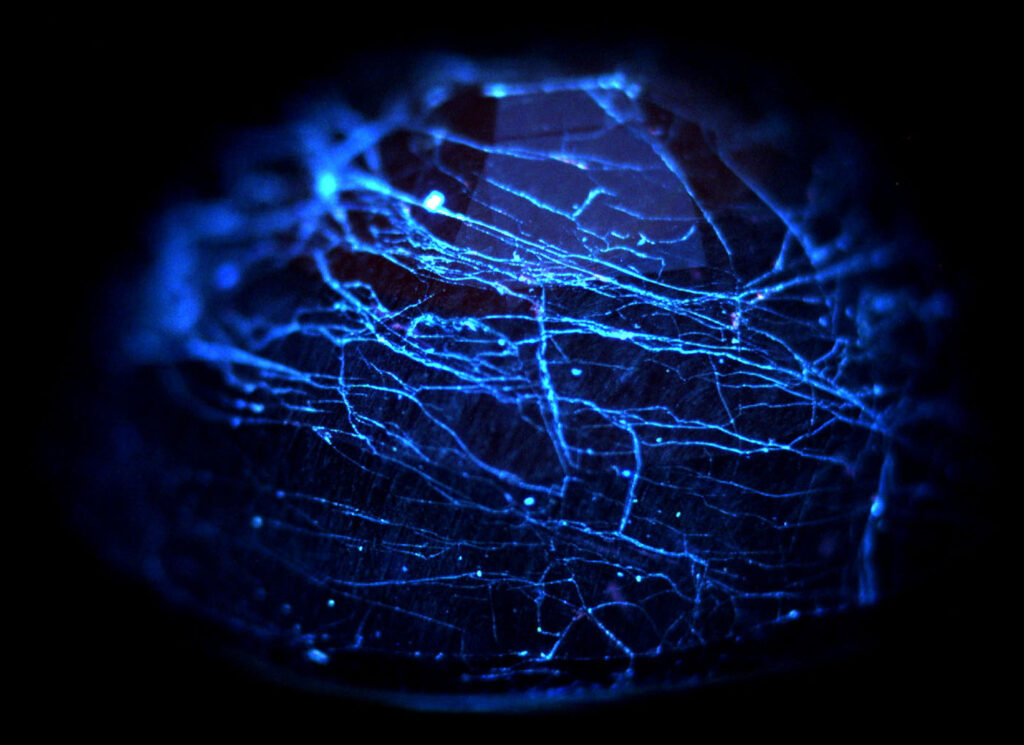
Fracture filling (clarity enhancement)
In simple terms, filling involves introducing a substance into natural fractures, micro-fissures, or pores within a gemstone – one that has optical properties similar to the host material (most often a refractive index close to that of the stone itself). In an untreated stone, a fracture acts like a small “air pocket”, and the boundary between air and stone strongly scatters light. This is why fractures often appear as bright, whitish veins cutting through the interior and reducing brilliance.
After filling, this boundary becomes far less pronounced: light is no longer reflected and “broken up” at the fractures to the same extent, making them less visible and giving the stone a more transparent overall appearance. The perception of color often changes as well – not because color suddenly appears out of nowhere, but because less light is lost to scattering. As a result, the stone may look “cleaner”, more saturated, and generally more visually attractive, especially under showroom lighting or in photographs.
This is where the key caveat comes in: the effect can be immediate and highly “photogenic”, but the intervention itself is more conditional than heat treatment. Filling does not alter the stone’s internal structure; it introduces an additional substance into its fractures. That means the stone comes with limitations: it may tolerate heat less well (for example, during jewelry repairs), may not withstand ultrasonic cleaning, steam, or aggressive chemicals, and over time the filling can change, become cloudy, or become more noticeable. When purchasing a filled stone, the client is therefore buying not only the appearance “here and now” but also a specific set of use and servicing constraints that would be far less relevant in an unfilled stone.
The most common types of fracture fillings
Filling is not a single, specific method – it is a whole group of treatments with one shared goal: to make fractures, fissures, or pores “disappear” by introducing a foreign substance into them. The differences between fillings are crucial, however, because they affect the durability of the result, how the jewelry can be cleaned and repaired, and how the market views such a stone.
The most commonly encountered are oil fillings (traditionally associated with emeralds), where a colorless oil or oil-based preparation is introduced into fissures to improve transparency and “calm” the stone’s internal appearance. This method has been used for many years, but the effect can diminish over time, and the stone requires gentle handling – especially when exposed to detergents, ultrasonic cleaners, or heat during jewelry work.
A second major group includes resin and polymer fillings (of varying quality, from basic to advanced), used when greater stability is required or when fractures are extensive enough that oiling alone does not produce a satisfactory result. Resins can be more durable than oils, but their presence is usually regarded by the market as a more significant intervention. With certain resins, potential issues include aging (clouding, yellowing) or sensitivity to high temperatures.
A separate category – often with the most far-reaching consequences – is glass filling (most widely discussed in the context of rubies). In extreme cases, the glass does not merely mask fractures; it becomes a significant optical component of the stone, improving clarity and appearance to such an extent that without it the material would look far worse. This is no longer a cosmetic enhancement, but a treatment that typically dramatically changes value and requires very clear disclosure.
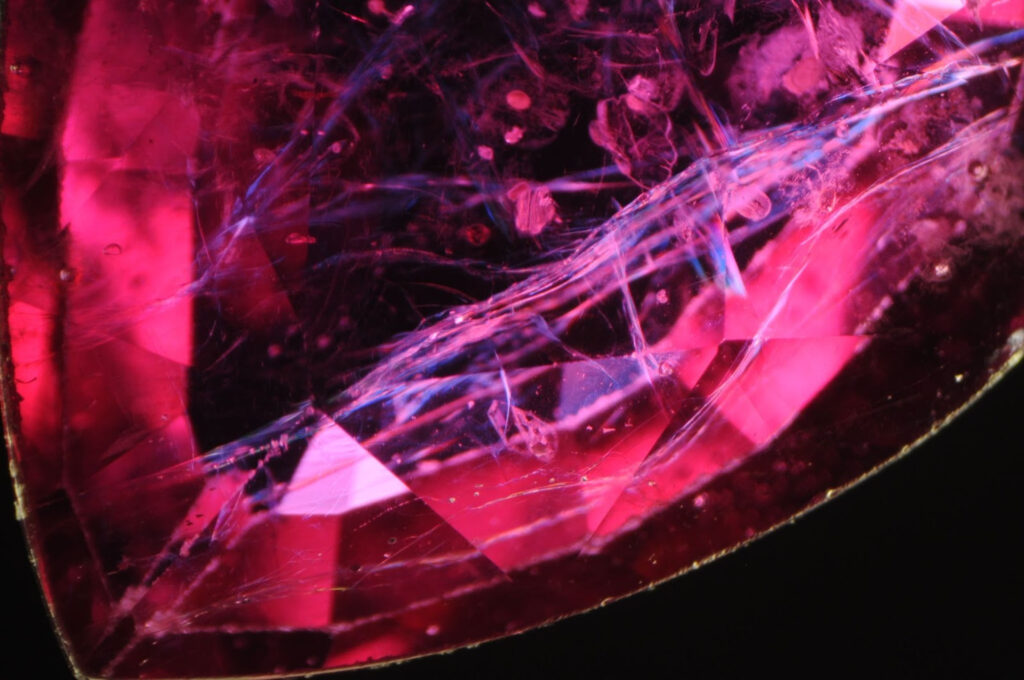
In the case of diamonds, one also encounters fracture filling with substances of a high refractive index (so-called optical fillers), which make fractures far less visible. The visual effect can be attractive, but in practice it may be sensitive to heat and certain cleaning methods. The mere fact of filling has a significant impact on grading and price, which is why a filled diamond and an unfilled diamond represent, commercially, two different product tiers.
It is worth remembering that regardless of the type, filling always means one thing: the stone has been enhanced in a way that cannot be reliably assessed “by eye” alone. This is why information about the extent of filling and the substance used is so important – these factors determine whether we are dealing with a minor correction or with an intervention that fundamentally changes the character of the stone.
What does fracture filling change in practice?
The most important change is optical: a fracture that previously appeared as a bright, whitish “vein” can almost disappear after filling. The stone becomes:
- more transparent,
- “cleaner” in appearance,
- sometimes more intense in colour (because less light is lost to scattering).
At the same time, filling almost always means that the stone becomes more demanding as a material. And this is the key point: the client is buying not only the appearance, but also a specific “behaviour package” in everyday wear and servicing.
Durability: where the complications begin
Fracture filling can be more or less durable – and this is precisely why this type of treatment should always be disclosed. In practice, there are three main risk areas:
- Heat: some fillings do not tolerate heating well (repairs, soldering, work on the setting).
- Chemicals and cleaning: ultrasonic cleaners, steam, and aggressive cleaning agents can weaken the filling or alter its appearance.
- Time and wear: the filling may become cloudy, leach out of fractures, become more visible over time, or trap dirt.
As a result, a filled stone may look excellent on the day of purchase, yet after improper cleaning, begin to look worse than before.
How does fracture filling affect value?
Very significantly – but not always in the same way. In emeralds, a certain level of filling is commonly encountered on the market; however:
- stones with minimal filling and good transparency are valued differently from those with intensive filling,
- “no filling” (when genuinely confirmed) is considered a premium attribute.
In rubies – especially those with glass filling – the pricing consequences can be dramatic. A stone may still be sold as a ruby, but its market value compared to a ruby without such intervention is usually incomparably lower.
In diamonds, the impact on value can be just as significant, although the mechanism is slightly different. Fracture filling can optically “raise” clarity by making fractures less visible, but the market treats this as a disqualifying factor in the premium segment. Such a diamond is not valued like a stone with naturally higher clarity, but rather as an “enhanced” diamond, with additional limitations in wear and servicing. This usually results in a clear price reduction compared to a comparable unfilled stone – often large enough to be noticeable even to those outside the trade.
Summary
Filling can create what, at first glance, looks like a genuine “upgrade”: fractures become less visible, transparency improves, and the stone begins to appear more premium. But unlike heat treatment, which typically produces a stable effect in normal wear, filling introduces an additional “component” into the stone – one that may react to heat, chemicals, ultrasonic cleaning, or even the passage of time.
That is why the key question is not simply “Is the stone beautiful?”, but: what makes it look cleaner, and how long is that effect likely to last? In emeralds, the market recognizes and accepts a certain level of filling, but the extent of the intervention and the substance used make a major difference to valuation. With glass-filled rubies, the value implications are often even more severe, because this is no longer cosmetic – it is a treatment that can entirely change a stone’s position in the market.
The biggest issue always arises in the same place: when filling is not disclosed and the price suggests a stone that is “naturally clean”. Transparency protects both sides: the client from disappointment and servicing limitations, and the seller from disputes, complaints, and loss of trust.
In the next part of the series, we will move on to irradiation – a treatment that can alter color very effectively, but requires a good understanding of color stability and of what exactly has been done to the stone.