
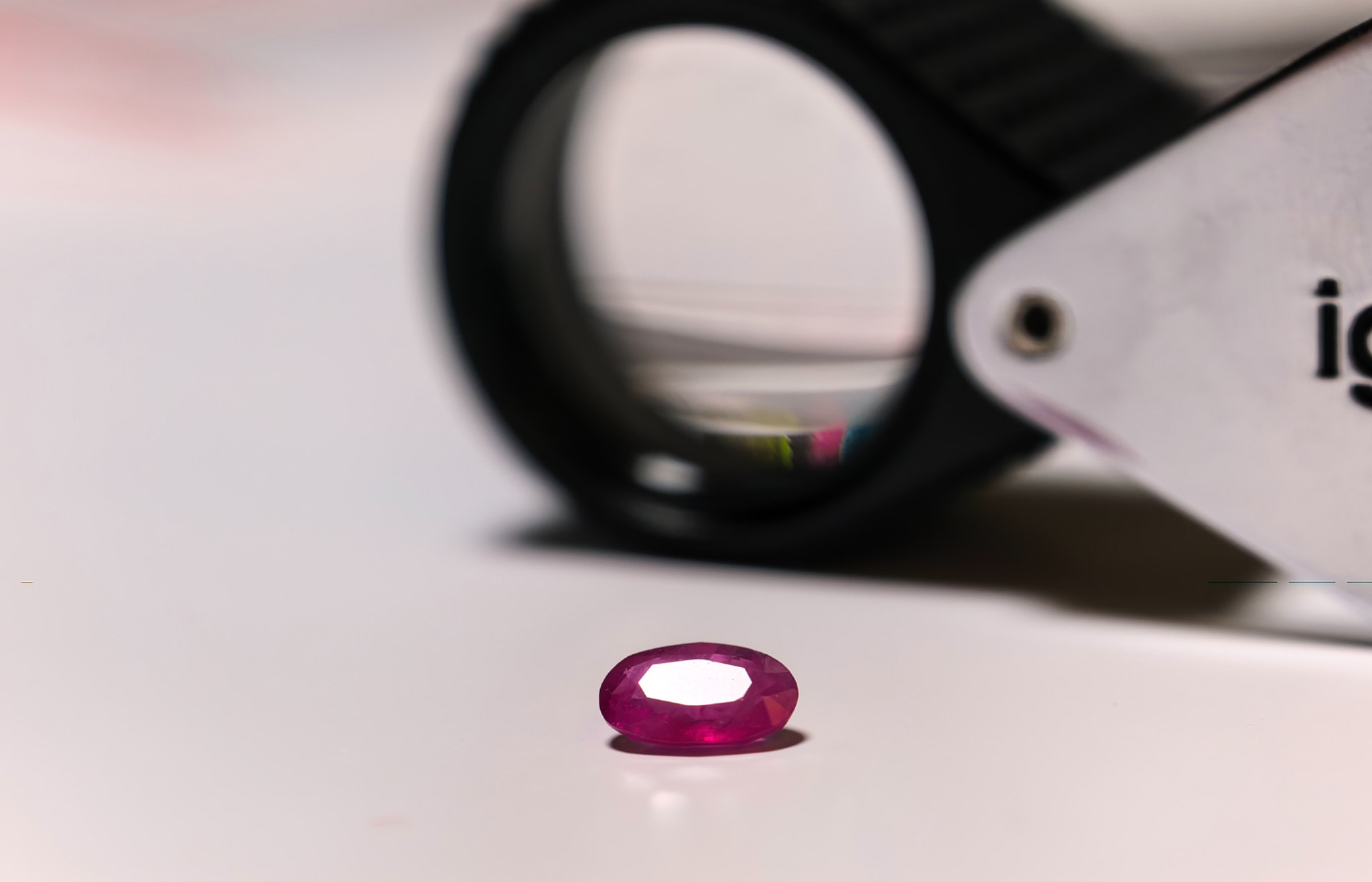
Coating is one of the most “deceptive” treatments encountered on the gemstone market. Not because it is always dishonest – sometimes it is used deliberately as a design effect – but because it can radically change a stone’s appearance without altering its interior. In other words, the color and the “wow effect” may come from a thin surface layer rather than from the stone’s natural color.
This is the fourth and final article in the series “Treatments and Enhancements of Gemstones.” In previous parts, we discussed heat treatment, filling, and irradiation. Now we turn our attention to coating – a treatment that works “on the outside,” and therefore often carries very different implications for durability of appearance, care, and jewelry servicing.
From the customer’s perspective, this has very concrete consequences: a coating can wear away, scratch, become dull, or partially come off, and then the stone begins to look different from how it did on the day of purchase. That is why, in this article, I explain what coating actually involves, why it is used, how it affects value, and how gemmological laboratories identify it – so that when buying (especially online), you know what to ask about and what to avoid.
What does coating involve?
Coating is a treatment that consists of applying a very thin layer of material to the surface of a gemstone, changing the way the stone reflects and transmits light. This is the key difference compared to many other enhancements: the stone’s “interior” is not modified, only its “skin.” And because the surface is the first point of contact between light and the stone, even an ultra-thin layer can significantly alter appearance – color, saturation, and sometimes also the character of luster and “fire.”
In practice, a coating works through several mechanisms at once. First, it can subtly filter light – absorbing some wavelengths and transmitting others – making the stone appear cooler, warmer, “cleaner,” or more intense. Second, with certain coatings, an interference effect appears: light reflects off the boundaries of the layer in such a way that rainbow-like reflections and angle-dependent color changes are produced. This is why a stone can look “magical” from one angle and much more ordinary from another.
It is also very important where the coating is applied. Some coatings cover the entire surface, but in commercial practice you also encounter “strategic” coating: only on the pavilion, around the girdle, or in selected areas. Such treatment is particularly difficult for a layperson to detect, because a set stone is usually viewed from the top. If the coating is on the underside, it can “boost” the color seen in the crown while remaining invisible without proper magnification and observation from the right angle.
In jewelry practice, the consequence is simple: because the effect is surface-based, it is also more vulnerable to real-life wear – friction, scratches, detergents, cosmetics, cleaning, and repairs. That is why coating can look spectacular at first, but requires conscious use and – most importantly – must be disclosed, because it affects durability of appearance and value.
Why are gemstones coated?
The reasons for coating vary widely, and it is worth separating them, because the same procedure can either be an honest design element or a way to “boost” the appearance of lower-quality material. In practice, coating is used primarily because it is fast, relatively inexpensive, and capable of delivering an immediate visual effect – and in jewelry, first impression often determines the purchase.
The first scenario (the least controversial) is coating as an aesthetic effect. In fashion jewelry or in projects where a specific “look” matters, a coating may be a deliberately chosen finish: it may add iridescence, a metallic sheen, shift the tone of color, or create an effect that cannot naturally be achieved within a given budget. Such a product is perfectly acceptable if it is clearly described: the customer buys a coated stone because they want that effect, just as they buy gold-plated jewelry knowing it is a surface layer.
The second scenario is coating as a commercial enhancement – and this is where most problems begin. A coating can:
- “cool” the color of a stone that appears too yellowish or brownish,
- boost saturation so the stone looks more expensive,
- even out the perception of color (making the stone appear more uniform),
- correct unwanted tones that would be visible in daylight,
- sometimes mask the impression of “emptiness” or weak life through specific reflective effects.
In online sales, coating can be particularly tempting because it can be “tuned” for presentation: the coating works best at a specific angle and under specific lighting, and promotional photos often enhance this effect. Additionally, localized coating (for example, only on the underside) is sometimes used, making the stone look excellent from the top when set, while the customer has no easy way to detect the layer without magnification and inspection from all sides.
There is also a third, more market-driven reason: adaptation to trends. Fashion for certain hues and effects (for example, an “icy” cool brilliance, intense tones, or iridescence) appears in waves. Coating allows manufacturers to respond quickly to demand, even if the natural supply of stones with such characteristics is limited or expensive. For the customer, this can be attractive – but only if they understand that they are buying a surface effect and the price reflects that fact.
Durability: why is coating a high-risk treatment?
A coating is a surface layer – and in jewelry, the surface is constantly at work. A stone rubs against clothing, comes into contact with cosmetics, and accumulates micro-scratches in everyday wear. That is why coating is one of the treatments most sensitive to real life – often more than customers expect.
The most common “wear path” looks like this: the coating begins to lose integrity first along the edges (the girdle, facet junctions), then in areas most exposed to friction. Subtle abrasion appears, which over time becomes visible as:
- uneven color,
- spots or streaks,
- reduced saturation,
- shifts in tone in specific areas of the stone.
Chemistry also plays a major role. Perfumes, hairsprays, cleaning agents, chlorinated water, and even some ready-made jewelry cleaning solutions can affect certain coatings – weakening them, dulling them, or causing micro-damage. “Professional” at-home methods can also be risky: ultrasonic or steam cleaning may reveal coating boundaries or accelerate degradation (this depends on the type of coating, but as a general precaution, coated stones should be treated more gently).
The most critical moment is jewelry servicing. Polishing the setting, tightening prongs, working with tools near the stone – all of this can mechanically damage the coating. If heat is involved (for example, during repairs), the risk increases. For this reason, information about coating is crucial not only for the customer but also for the jeweler: it allows the use of safe working methods.
How does coating affect value?
In most market segments, coating lowers a stone’s value, because in the eyes of buyers and the secondary market it is a feature that is:
- less durable,
- less “natural” in a collector’s sense,
- harder to assess (because the stone’s “true” color is partially obscured by the coating effect).
In practice, this means that a coated stone may look very impressive, but its price should not be compared one-to-one with an uncoated stone of similar appearance. The market pays for features inherent to the material itself (color, clarity, stability), and a coating is an addition that can change over time. That is why, in resale or insurance valuation, coating is often treated as a significant risk factor and a reason for lower value.
There are, however, two important nuances. First: if the coating is openly disclosed and is part of the design (fashion jewelry), the product has its own aesthetic and functional value – just of a different type than a “premium gemstone.” Second: coating can sometimes create a look that the customer genuinely loves, so subjective value may be high. The problem arises when the price suggests a naturally higher-grade stone and the coating is not disclosed.
The most honest summary is therefore this: coating does not automatically disqualify a purchase, but it must be clearly disclosed, because it affects valuation, durability of appearance, and rules of use. If the customer understands these consequences, they can consciously decide whether they prefer an immediate visual effect or long-term material value without surface modifications.
Summary
Coating can make a gemstone look exceptionally attractive – it can shift the hue by a grade or two, increase saturation, or create a fashionable iridescent effect. But because it is a surface treatment, its defining feature (and its greatest risk) is that it can change over time: wear away, scratch, become dull, or reveal the boundaries of the layer. This affects not only long-term appearance, but also jewelry servicing and how safely the stone can be cleaned.
The fairest rule for customers is this: coating does not have to disqualify a purchase, but it must be disclosed and priced accordingly. If you are looking for everyday jewelry and care primarily about the visual effect, a coated stone can be a good choice – provided you know how to treat it. If, however, you are buying with long-term value, resale, or the premium segment in mind, coating is a critical piece of information and will usually work against the valuation.